Audience-first SEO starts with a simple question: what does the reader actually need? Keywords come second.
I learned this by fixing a page that wasn’t working. It was a long, generic SEO guide. I rebuilt it as a step-by-step resource with practical examples and checklists. Time on page rose by roughly 20%, and bounce rate fell by around 10%. The page also gained a little in organic rankings and clicks.
In this guide, I’ll explain what audience-first SEO is, share the process I use, and show where it goes wrong. You’ll also get a first step you can take this week.
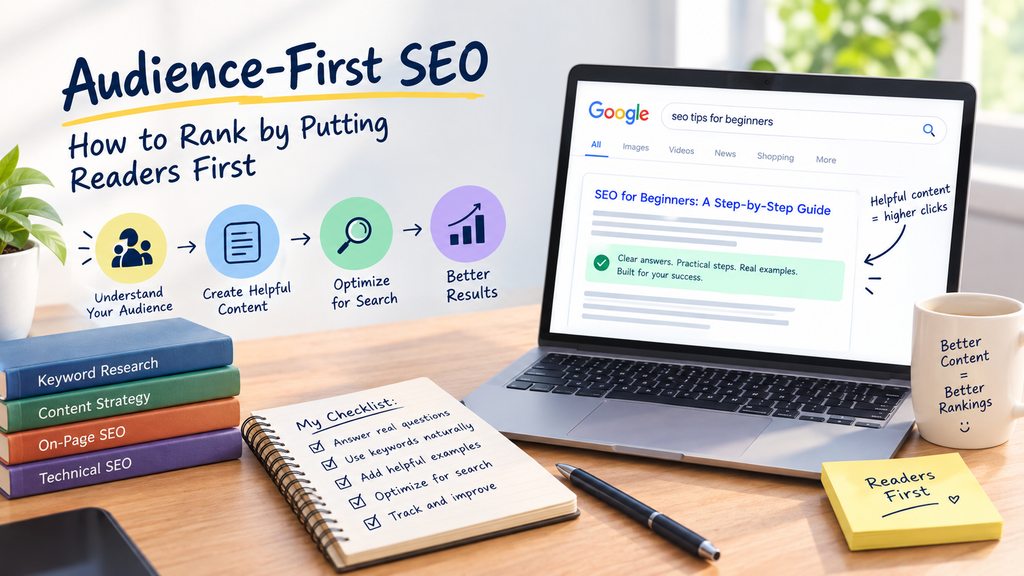
What Is Audience-First SEO?
Audience-first SEO means you plan, write, and structure content around your readers’ questions and problems. Then you optimize it so search engines can find and understand it.
Google backs this approach. Its ranking systems aim to prioritize helpful, reliable information created to benefit people, not content made to manipulate rankings. Its guide to people-first content lays out the self-check questions.
Here’s how the two approaches compare:
| Keyword-first | Audience-first | |
| Starting point | A target keyword | A reader’s question or problem |
| Keyword use | Repeated wherever possible | Natural, with related terms |
| Structure | Built around headings for keywords | Built around what readers need next |
| Success measure | Rankings alone | Engagement, clicks, and rankings |
Why Audience-First SEO Works
Search engines want to send people to pages that satisfy them. Google’s guidance asks whether a reader will finish your page feeling they’ve learned enough to reach their goal. If your page does that, you’re aligned with what the ranking systems are built to reward.
There’s a practical benefit too. Readers who find answers quickly stay longer and trust you more. That’s what I saw in my example above.
One honest limit: I can’t prove that the higher time on page caused the ranking lift. Many factors move together. But a page that serves readers gives every other signal a better chance.
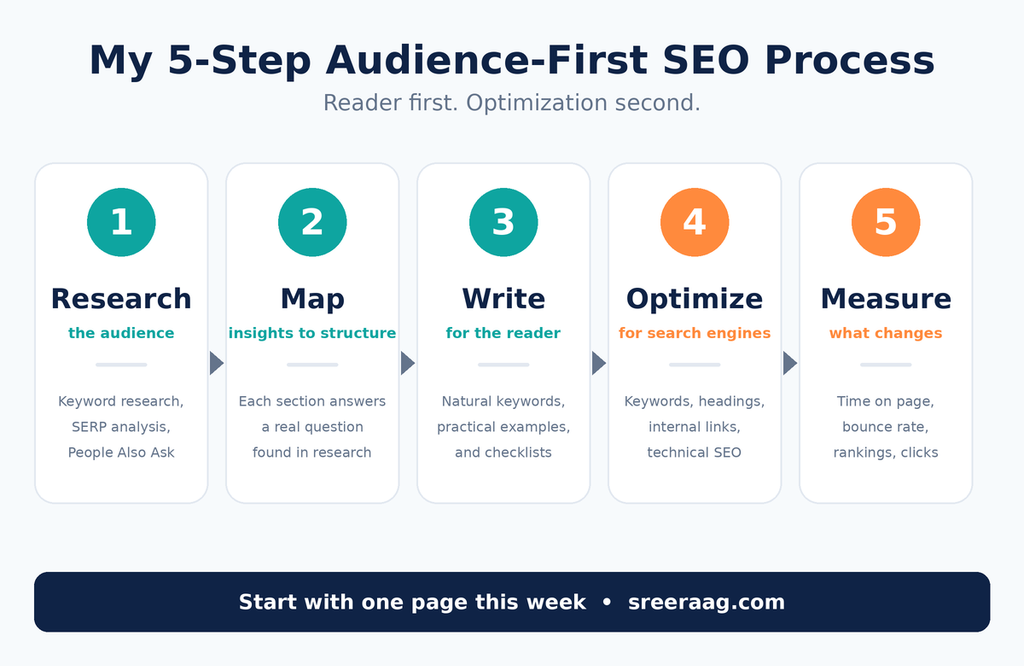
My Audience-First SEO Process
I follow the same five steps for every page:
- Research the audience. I use keyword research, SERP analysis, competitor content, and related questions, such as “People Also Ask,” to understand search intent and pain points.
- Map insights to structure. Each section answers a question the research surfaced. The main query gets a clear answer early.
- Write for the reader. I use keywords naturally, add related terms, and include practical examples and checklists.
- Optimize for search engines. I check keywords, structure, internal links, and technical SEO.
- Measure what changes. I track time on page, bounce rate, rankings, and clicks.
Notice that the reader comes first in the order. Optimization happens after the page already helps someone.
Real Example: Rebuilding a Generic SEO Guide
The original guide was long and broad. It covered a lot but gave readers little to act on. I changed three things:
- I restructured it into a clear, step-by-step format.
- I added practical examples so readers could see each idea working.
- I added checklists so readers could apply the steps immediately.
The results after the update:
- Time on page: up roughly 20%
- Bounce rate: down around 10%
- Organic rankings and clicks: a small improvement
Keep in mind that this was one page. Results will vary by site, topic, and competition. Treat it as a pattern worth testing.
Where Audience-First SEO Goes Wrong
The biggest mistake I see is keyword stuffing. People force the target keyword into every sentence, and the content turns unnatural and hard to read.
I once worked on a page like this. It repeated the target keyword in its headings and in almost every paragraph. It read like a robot wrote it. My fix had four parts:
- Cut the unnecessary repetition.
- Work in related terms naturally.
- Improve the structure.
- Rewrite sections so they answered the reader’s questions clearly.
Search intent is the better guide. If you know what the reader wants, you rarely need to force a keyword.
Readers First Does Not Mean Readers Only
You’ll hear the advice “write for readers and the rankings will follow.” I mostly agree, with one catch. Great content still needs to be technically accessible and aligned with search intent.
So I put readers first while still handling the basics:
- Keywords: Use the primary keyword and related terms naturally.
- Structure: Use clear headings so readers and search engines can scan the page.
- Internal links: Connect related pages, such as your meta tags guide and meta description best practices post.
- Technical SEO: Make sure the page is crawlable, loads quickly, and works on mobile.
How to Start Audience-First SEO This Week
You don’t need to rewrite your whole site. Start with one page.
- Find your audience’s main questions. Use keyword research, SERP analysis, and “People Also Ask” results to spot their questions, problems, and search intent.
- Pick one page. Choose a page that matters to your business and could serve readers better.
- Create or improve it. Answer those needs clearly and naturally, and more completely than the pages that rank now.
- Check it against Google’s questions. Does it offer original information? Does it give substantial value compared with other results? Does it avoid simply rewriting other sources?
Then track your results. My process gives you the metrics to watch: time on page, bounce rate, rankings, and clicks.
Audience-First SEO: FAQs
What is audience-first SEO?
It’s an approach that builds content around readers’ questions and search intent first, then optimizes it for search engines.
Is audience-first SEO the same as people-first content?
They’re closely related. Google uses the term “people-first content,” and audience-first SEO applies that idea to your whole content process.
Does audience-first SEO mean ignoring keywords?
No. Keywords still guide your topic and language. You just use them naturally and let search intent lead.
Do I need to rewrite my whole site?
No. Start with one important page, measure the results, and then repeat the process.
Conclusion
Audience-first SEO isn’t a trick. It’s a habit of asking what readers need before you think about what algorithms want.
Your action list:
- Research your audience’s questions with keyword research, SERP analysis, and “People Also Ask.”
- Map what you learn into a clear page structure.
- Use keywords and related terms naturally.
- Cover the technical basics so search engines can find the page.
- Measure time on page, bounce rate, rankings, and clicks.
Looking for a freelance digital marketer in Kochi to grow your online presence? I provide result-focused digital marketing services designed to help businesses build their brand, reach the right audience, and generate more opportunities online. My services include SEO, social media management, content marketing, and Google Ads, with strategies tailored to your business goals and target audience. Whether you are a startup, local business, or growing brand, I focus on practical and effective digital marketing strategies that improve online visibility and support long-term growth.