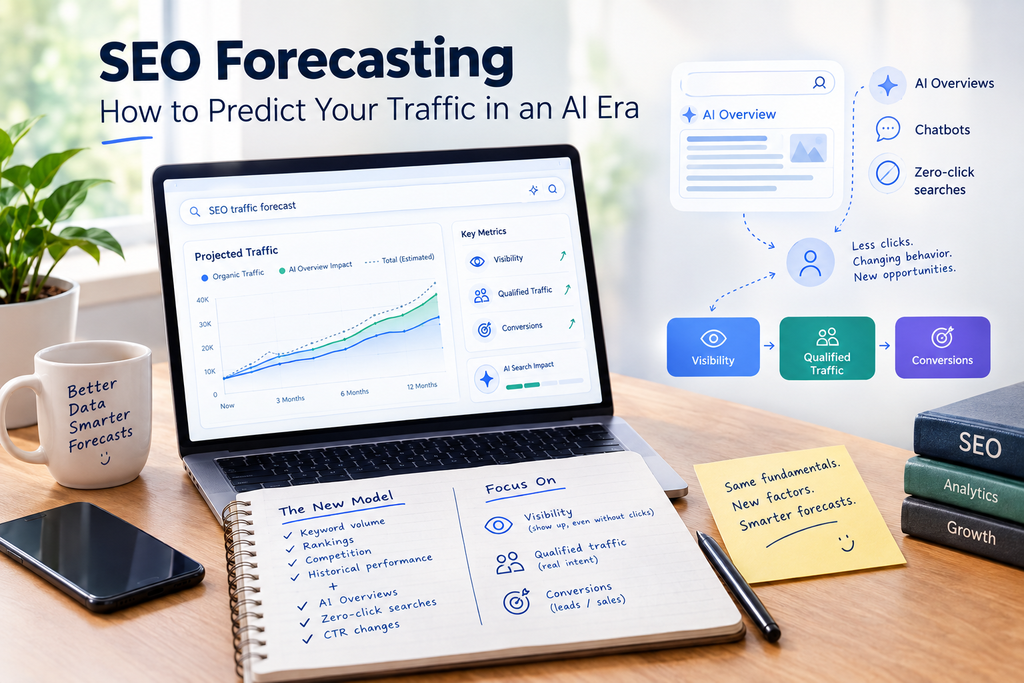
SEO forecasting used to be a fairly straightforward exercise: pull keyword volume, factor in your current rankings, account for competition, and project traffic from there. That approach still matters — but it’s no longer enough on its own. AI Overviews, zero-click searches, and chatbots answering questions directly have changed how people interact with search results, and any forecast that ignores that is going to be wrong.
I’ve built SEO traffic forecasts by analyzing keyword search volume, current rankings, competition, and historical performance, using those insights to estimate potential organic traffic and set realistic growth targets. That foundation still holds — but the way I apply it has changed significantly.
Why Traditional Forecasting Isn’t Enough Anymore
The old model assumed a fairly stable relationship: rank well, get clicks, convert some percentage of those clicks. AI search breaks that chain in a few places. When an AI Overview or chatbot answers a question directly, the click might never happen at all — even if your content ranks well or gets referenced.
That’s why AI search makes SEO forecasting less predictable than it used to be. It’s not that the old inputs are wrong — it’s that they’re incomplete without factoring in AI Overviews, zero-click searches, and reduced organic click-through rates alongside traditional ranking data.
What to Actually Track Now
Rather than relying only on projected organic clicks, the smarter approach shifts focus toward:SEO forecasting
- Visibility — are you showing up, even if it doesn’t always result in a click?
- Qualified traffic — of the clicks you do get, how many are from people with real intent?
- Conversions — ultimately, what matters is whether visibility and traffic translate into leads or sales
This doesn’t mean traffic numbers stop mattering. It means they stop being the only thing that matters.
The Mistake Most Forecasts Still Make
The most common mistake is relying only on keyword volume and ranking positions while ignoring AI Overviews, zero-click searches, and changing user behavior. A forecast built purely on “rank #3 for this keyword = X clicks” is built on an assumption that’s increasingly unreliable.
Forecasts should account for potential CTR changes and focus on qualified traffic and conversions, not just estimated clicks. If your SEO forecasting model hasn’t been updated to reflect this shift, the numbers you’re presenting to stakeholders may already be overly optimistic.
A Two-Stage Forecasting Process That Works
Here’s the actual process for building a SEO forecasting that holds up:
Stage 1: Establish Your Baseline
Analyze current traffic, rankings, keyword volume, competition, and historical performance. This gives you a realistic starting point grounded in what’s actually happening today — not assumptions.SEO Forcasting
Stage 2: Project Forward With AI Search Factored In
Estimate ranking and CTR changes, explicitly account for AI search impact, and project traffic, leads, and conversions over time — not just clicks. This is the stage most outdated SEO forecasting models skip entirely.
Traditional Forecasting vs. AI-Era Forecasting
| Factor | Traditional Forecasting | AI-Era Forecasting |
| Primary input | Keyword volume + rankings | Volume, rankings, AI Overview/zero-click impact |
| CTR assumption | Relatively stable by position | Variable — can drop significantly with AI Overviews |
| Success metric | Projected organic clicks | Visibility, qualified traffic, conversions |
| Model structure | Single-point projection | Scenario-based, adaptable ranges |
| Risk of being wrong | Moderate | High, if AI search impact is ignored |
How to Build a More Realistic Forecast Today
If you’re building or updating an SEO forecasting right now, here’s where to focus:
- Build your forecast around realistic CTR and conversion assumptions, not just keyword rankings and search volume
- Use a range of scenarios rather than a single fixed projection — AI search’s impact varies by query type and industry
- Track visibility, qualified traffic, and conversions alongside raw clicks
- Revisit your forecast more frequently than you used to — AI search behavior is still evolving
A Note on Limitations
How much AI search affects your traffic depends heavily on your industry and query types — informational queries tend to see more AI Overview impact than transactional ones. This analysis reflects patterns observed across current AI search behavior, but these platforms update frequently, so any forecast should be treated as a working model, not a fixed prediction.
FAQs
Q: Is traditional SEO forecasting still useful?
Yes — keyword volume, rankings, and historical performance are still a necessary baseline. They’re just no longer sufficient on their own.
Q: How much can AI Overviews reduce organic clicks?
It varies significantly by query type and industry, which is exactly why scenario-based forecasting matters more now than a single fixed projection.
Q: What should I prioritize if my forecast keeps missing the mark?
Check whether your model accounts for AI Overview and zero-click impact — if it’s still assuming a stable rank-to-click relationship, that’s likely where the gap is coming from.
Conclusion
SEO forecasting in an AI era still starts with the fundamentals — keyword volume, rankings, competition, and historical data. But stopping there is no longer enough.SEO forecasting Building in AI Overview impact, zero-click behavior, and a focus on qualified traffic and conversions — rather than clicks alone — is what separates forecasts that hold up from ones that quietly fall apart the moment stakeholders check results against reality.
Looking for a freelance digital marketer in Kochi to grow your online presence and reach the right audience? I help businesses build effective digital strategies through SEO, social media management, and Google Ads. With a focus on improving visibility, attracting qualified traffic, and generating meaningful leads, I create practical marketing solutions tailored to each business’s goals. Whether you want to improve search rankings, strengthen your social media presence, or drive targeted traffic through paid advertising, I can help turn your digital marketing efforts into measurable growth.