Getting education marketing right isn’t about reaching as many people as possible. It’s about reaching the right prospective students, at the right moment, with a message that actually makes them want to enquire. Schools, universities, and ed-tech brands that get this wrong pour budget into awareness and wonder why enquiries don’t follow. The ones that get it right build campaigns around intent, clarity, and trust.
I’ve spent time applying digital marketing strategies specifically to education-focused audiences — SEO, social media, and Google Ads — with the goal of increasing visibility, attracting relevant prospects, and converting them into genuine enquiries. Here’s what actually works heading into 2026.
Why Reach Alone Doesn’t Drive Enrollments
A lot of education marketing still leans heavily on awareness — banner ads, broad social campaigns, generic messaging. The problem is, awareness without a clear reason to choose your institution rarely converts.
The most common mistake I see is schools focusing heavily on reach without clearly communicating why a student should choose their course or institution over the alternatives. Visibility gets you noticed. It doesn’t get you enquiries. That takes a strong value proposition, a clearly defined audience, and CTAs that make the next step obvious.
A Campaign That Actually Moved the Needle
In one education-focused campaign, enquiries improved by targeting high-intent keywords and refining ad messaging to match exactly what prospective students were searching for — not generic course descriptions, but the specific questions and concerns driving their search.
That alone wasn’t enough, though. Optimizing the landing page and CTAs is what turned that more qualified traffic into actual enquiries. Getting someone to click is only half the job; the landing page has to close the gap between interest and action.
A Framework for Planning an Education Marketing Campaign
Here’s the education marketing process that consistently works, from scratch:
- Define your target students, goals, and key message. Get specific — “prospective students” is too broad. What program, what stage of decision-making, and what’s motivating them?
- Research their search behavior and choose the right channels. SEO, social media, and Google Ads all serve different intents — match the channel to where your audience actually is.
- Build the campaign, landing pages, and tracking setup. This is where messaging meets execution — the landing page needs to speak directly to the ad or keyword that brought someone there.
- Monitor leads and conversions, then optimize. Campaign performance data tells you what’s actually working, not what you assumed would work.
This sequence matters because skipping the research step is exactly what leads to the reach-without-relevance problem many education marketing campaigns face.

What’s Changing in Education Marketing for 2026
A few shifts are reshaping how education marketing works right now:
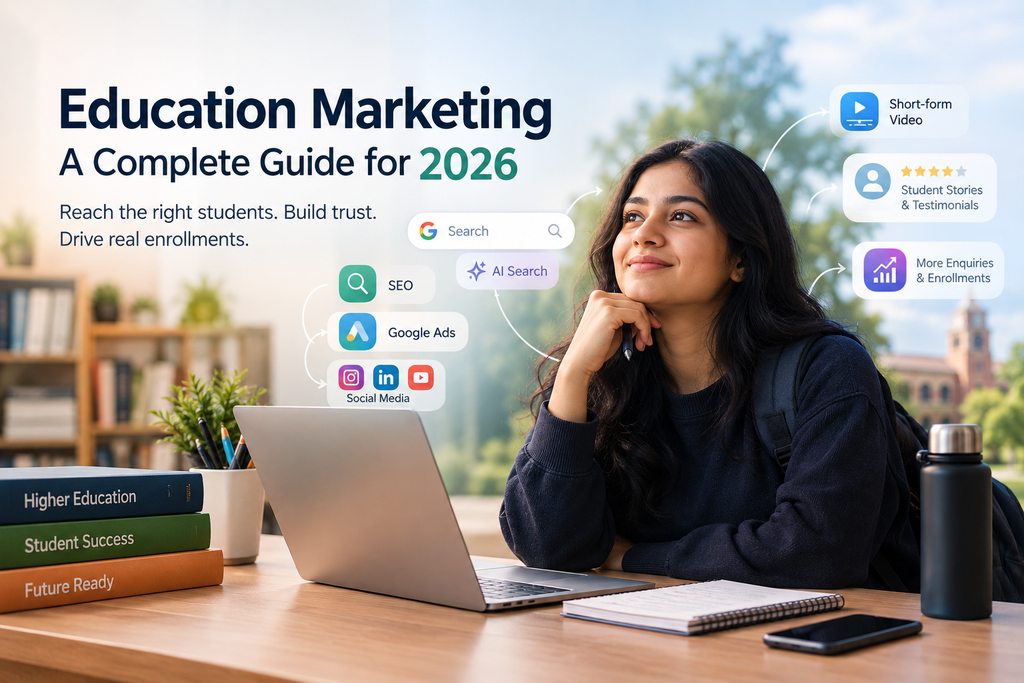
- AI-driven and personalized marketing — generic messaging is being replaced by more targeted, relevant content built around specific student needs
- Search visibility across Google and AI-powered platforms — prospective students are increasingly asking AI assistants questions directly, not just searching Google
- Short-form video — becoming a bigger part of how institutions build familiarity and trust before a prospect ever visits a website
- Strong social proof — testimonials, outcomes, and real student stories carry more weight than polished brand messaging
- Conversion-focused campaigns — the emphasis is shifting from pure awareness to campaigns designed around building trust and driving action
Traditional vs. 2026-Ready Education Marketing
| Factor | Traditional Approach | 2026-Ready Approach |
| Primary goal | Maximize reach and impressions | Attract and convert high-intent prospects |
| Content style | Generic, broad messaging | Personalized, specific to student needs |
| Search focus | Google rankings only | Google + AI-powered search platforms |
| Trust building | Brand messaging | Social proof, outcomes, real student stories |
| Content format | Long-form web pages | Mix of short-form video and clear web content |
Practical Steps to Apply This Today
If you’re planning your next education marketing campaign, start here:
- Get specific about who you’re targeting — avoid broad, generic audience definitions
- Research the actual questions and concerns driving prospective students’ searches
- Build landing pages that directly match the intent behind your ads or keywords
- Add genuine social proof — real outcomes and student stories, not just brand claims
- Track leads and conversions from the start, not just clicks or impressions
A Note on Limitations
What works varies by institution type — a university marketing a four-year degree program faces a very different decision timeline than a short-course provider or an ed-tech platform. Budget size, audience maturity, and program type all affect which channels and tactics will perform best. Treat this guide as a strong starting framework, not a fixed formula for every institution.
FAQs
Q: What’s the biggest mistake schools make in their marketing?
Focusing on reach and awareness without clearly communicating why a student should choose their institution — visibility alone doesn’t drive enquiries.
Q: How important is search visibility in 2026?
Very — but it now extends beyond Google. Prospective students are increasingly using AI-powered platforms to research programs, so visibility needs to account for both.
Q: Do I need video content to compete in education marketing?
It’s becoming increasingly important. Short-form video helps build familiarity and trust with prospective students before they ever visit your website.
Conclusion
Education marketing in 2026 rewards specificity over scale. The institutions winning enquiries aren’t the ones with the biggest reach — they’re the ones that clearly understand their prospective students, meet them with the right message on the right channel, and follow through with a landing experience that makes the next step obvious. Start with a clear framework, prioritize search visibility across both Google and AI platforms, and build trust with real social proof — that combination is what turns interest into enrollment.
Looking for a freelance digital marketer in Kochi to grow your online presence and reach the right audience? I help businesses build effective digital strategies through SEO, social media management, and Google Ads. With a focus on improving visibility, attracting qualified traffic, and generating meaningful leads, I create practical marketing solutions tailored to each business’s goals. Whether you want to improve search rankings, strengthen your social media presence, or drive targeted traffic through paid advertising, I can help turn your digital marketing efforts into measurable growth.